WILLIAM ROPER-CURZON: Reflections of Mani
September 10 – October 24, 2026
Artist Walk-through: Thursday, September 10, 5:30 pm
Opening Reception: Thursday, September 10, 6–8 pm
CULT Aimee Friberg | 1401 16th Street, San Francisco
CULT Aimee Friberg is pleased to present Reflections of Mani, a solo exhibition of new paintings by British-born, Athens-based artist William Roper-Curzon. Rooted in the landscape of Greece’s Mani Peninsula, the exhibition brings together paintings made directly in the landscape alongside larger works developed from memory in the artist’s studio in Athens. The exhibition runs from September 10 to October 24 at CULT Aimee Friberg, 1401 16th Street. The artist will be present on September 10 from 6–8 pm for a reception, with a walk-through preceding the opening at 5:30 pm.
At the southern edge of the Peloponnese, Mani is one of Greece’s wildest and most elemental landscapes—a terrain of exposed limestone, rocky outcrops, pebbled beaches and steep hills descending into crystalline turquoise waters. Olive trees, prickly pears and silvery-green scrub emerge from the dry earth, while the colors of the hills shift between purple, brown, yellow and green beneath the bright, intense light of an unobstructed sun.
Roper-Curzon has returned repeatedly to Mani, drawn to both its physical rawness and the sense of an older world that remains palpable there. Pausanias, the geographer famous for his travel writing and descriptions of Greece in the Roman era, wrote of its sacred places and traditions, while centuries later Constantine VII recorded the persistence of ancestral beliefs and practices among its people. For Roper-Curzon, this history is not separate from the landscape but embedded within it. Mani is truly a living palimpsest, its terrain bearing and accumulating traces of geological time, ancient mythology, ritual, conflict, generations of cultivation and human habitation—all occupying the same ground and continuing to make themselves felt in the present.
The majority of the paintings in Reflections of Mani were made en plein air, painted directly in oil on board while Roper-Curzon was spending extended periods on the peninsula. Making these works is an intensely physical practice, requiring stamina and endurance. Roper-Curzon hikes into the rugged terrain carrying his materials, immersing himself in conditions that are as demanding as they are beautiful—exposed rock, relentless light and heat, prickly vegetation, the glinting aquamarine waters and vast horizons. Jewel-toned poppies and other wildflowers, evergreen shrubs, spiny plants and aromatic herbs punctuate the otherwise arid landscape. The body becomes an instrument of perception: feet register the uneven ground, skin absorbs the heat and wind, eyes adjust to the glare, and breath changes with exertion. Bombarded by light, heat and color, painting becomes less an act of observation than one of surrender—a process of stripping away the unnecessary, working instinctively, and responding to what is happening in a particular place and moment.
This physical immersion also connects the artist to the layered history of the peninsula. Mani’s ancient and ancestral past is not presented as a distant subject to be illustrated, but as something encountered somatically through movement, duration and attention. Walking through the landscape, pausing to paint, and returning repeatedly to the same terrain create a form of embodied historical awareness. The past seems to persist not only in archaeological remains or written accounts, but in the rhythms of the land itself—in the routes between villages, the persistence of local customs, and the sensation of inhabiting a place shaped by generations of human and nonhuman life.
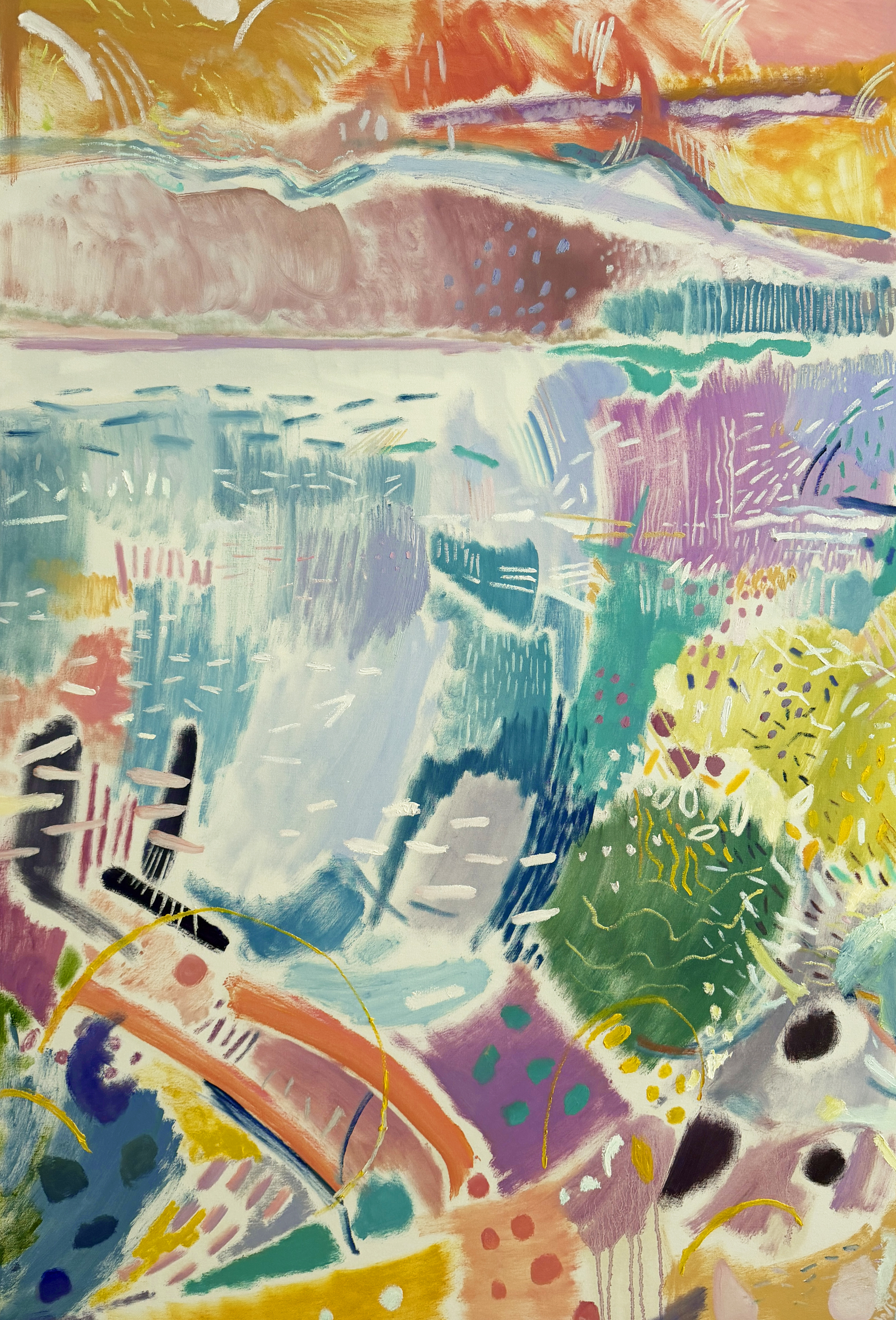
The exhibition’s larger oil-on-canvas paintings extend this process in a different direction. Made after Roper-Curzon returned to his Athens studio, they draw upon memory rather than direct observation. Forms become more abstracted and color untethered from naturalistic description, giving the works an ethereal and almost psychedelic quality. Memory becomes a kind of threshold through which the physical experience of Mani mingles with something less tangible—the atmosphere, mythology and ancient presence of the place. In his geographical account of the region, Pausanias connects the island of Cranae, just off present-day Gytheio, to Homer’s tale of Paris and Helen’s flight from Sparta toward Troy. In these studio paintings, memory allows the landscape to shift away from the literal and toward something more intuitive and unknown. The distinction between these two modes of working—one immersed physically in place, the other channeling its sensations at a distance—creates a productive tension throughout the exhibition. What remains in the studio is not simply an image of Mani, but a bodily residue: the remembered pressure of the terrain, the intensity of the light, the pace of walking, and the feeling of having been altered by contact with the place.
Roper-Curzon is a painter’s painter, deeply versed in color theory and possessing a confident, intuitive command of palette. Color in these works is both observational and psychological. The bright spectrum of light from deep winter to late spring is translated through intense, saturated hues: crystalline turquoise seas; rocky outcrops and silvery greens; hills that move through purple, brown, yellow and green; and skies that erupt into magenta and orange at sunset. Rather than reproducing the colors of Mani literally, Roper-Curzon heightens and rearranges them, allowing color to carry the sensation and energy of the landscape. Color becomes another form of bodily knowledge—something felt before it is interpreted, capable of evoking heat, glare, vertigo, calm and exhilaration.
His paintings are not carefully constructed representations of place. They are immediate responses to its genius loci—the atmosphere, energy and physical presence of a landscape as it is experienced. Painting requires complete immersion in the moment. At times, Roper-Curzon describes the process as almost trance-like, a heightened state in which the boundary between painter and landscape briefly begins to dissolve. This dissolution is not an escape from history but a way of encountering it differently: through sensation, repetition and the body’s capacity to register what exceeds conscious explanation.
There is something physical in this connection: a sense of being rooted in the ground and breathing with the landscape rather than simply observing it. It is from this state that the paintings emerge—raw, instinctive and alive. Reflections of Mani does not seek to reproduce the peninsula so much as hold onto something less tangible: the sensation of being within it, the historical and mythic layers that continue to inhabit it, and the primordial energy that makes itself felt through the body before it can be named.
ABOUT THE ARTIST
William Roper-Curzon is a British painter who has been based in Greece for the last decade. His animated paintings explore emotive and inner states through landscapes, portraits and still lifes. Dynamic brushwork evokes narrative suggestion, while his use of color explores the ways in which hues react to and co-vibrate with one another. Roper-Curzon’s current work draws upon his surroundings, focusing on the rugged drama of rural Greece and the urban vitality of Athenian characters.
Roper-Curzon’s landscapes often zoom in on geological formations and elements of the Aegean, at times combining observed scenes with imagined additions to create luminous imagery that balances intricate detail with loose expressivity. Painting en plein air whenever possible, and directly from a model for portraiture, Roper-Curzon’s work is decidedly an old-world practice grounded in the contemporary. Taking cues and conventions from historical painting, he reinterprets traditions of gesture, color and technique through his own visual language. He has spent significant periods painting throughout Greece, with the landscape of the Mani Peninsula becoming a central focus of his recent practice.
Roper-Curzon studied at City & Guilds of London Art School and The Prince’s Drawing School, now the Royal Drawing School, and has undertaken artist residencies at Holker Hall and Dumfries House in the United Kingdom.
He has exhibited internationally in solo and group exhibitions in London, Paris and Athens. Selected exhibitions include Art Barter, London (2009); a solo exhibition with Aretha Campbell, London (2010); TJ Boulting, London (2012); Honoré Visconti, Paris (2014); solo exhibitions at Hartnoll & Daughter, London (2014 and 2016); Degree of Darkness at Rook & Raven, London (2014); presentations of works on paper with Laura Lopes (2021–23); Skoufa Gallery, Athens (2024); and Recent Works, a solo exhibition with Sonsino Turcan, London (2024).
Roper-Curzon and his husband live between Athens, Greece, and Hampshire, England.